Presentation Outline
Welcome
This presentation defines the Doctrine’s institutional role.
The Malone Primer is a high-level map of Malone Doctrine. It shows:
- what the Doctrine is;
- what it is intended to accomplish;
- how its governing documents are ranked;
- which areas of life it governs;
- how the normative Doctrine differs from the explanatory Malone Primer;
- which strategic problems it addresses;
- how Malone institutions relate to it; and
- which practical maxims illustrate its operating mentality.
The design moves from definition, to authority, to application, and finally to the intended strategic outcome.
What It Is
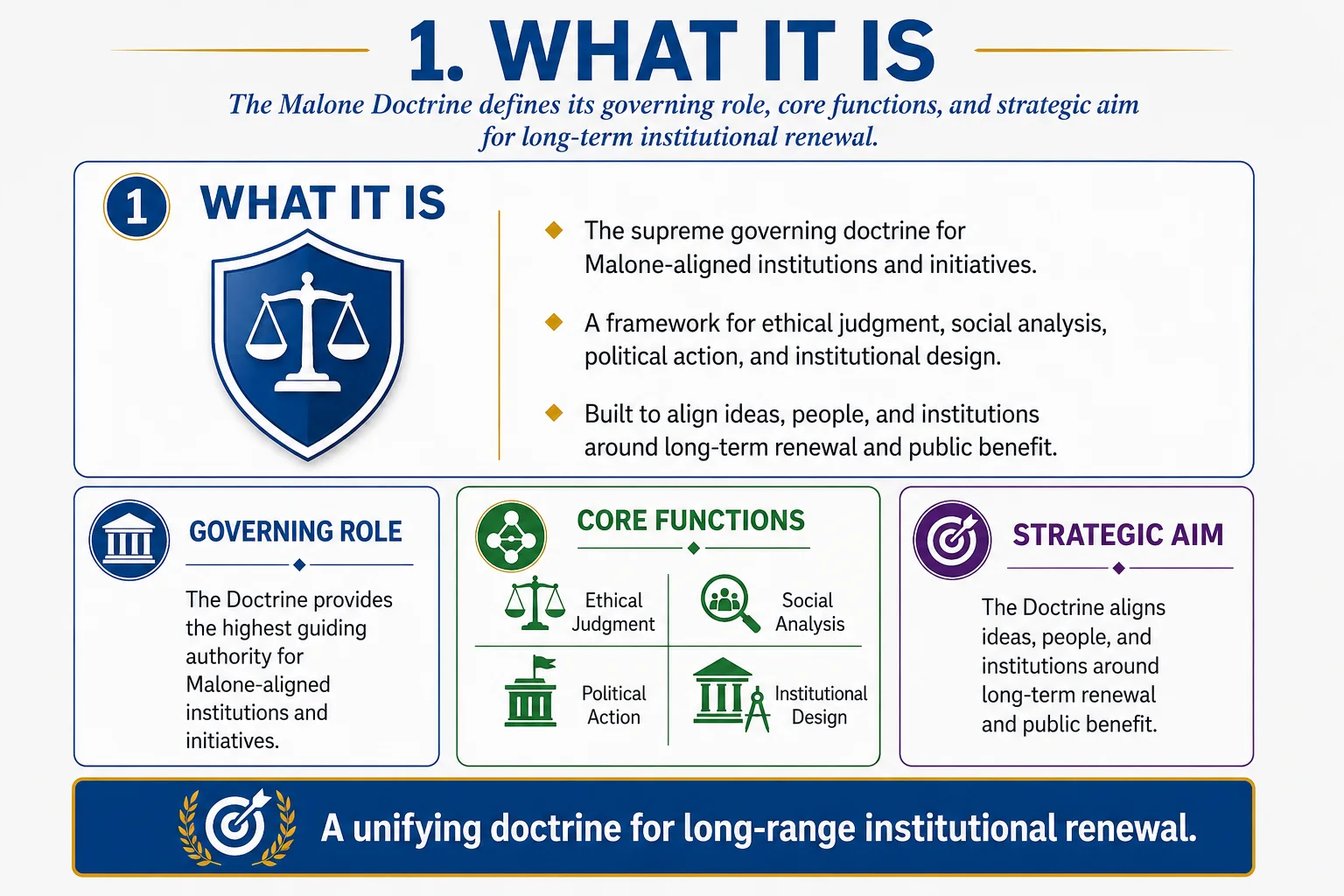
“Malone Doctrine”
The title identifies the system as a unified doctrine rather than merely a collection of opinions, essays, policies, or programs.
“A political, social, and economic doctrine for institutional renewal”
This subtitle establishes its scope.
- Political means it addresses government, political power, representation, public policy, and collective decision-making.
- Social means it addresses families, communities, culture, conduct, identity, organization, and social relations.
- Economic means it addresses markets, capital, employment, ownership, production, institutional finance, and material development.
- Institutional renewal means the Doctrine is not limited to criticizing existing conditions. It seeks to build, reform, strengthen, and coordinate institutions capable of producing durable results.
Purpose statement
African American family and community revival through ethics, organization, institution-building, and strategic governance.
This identifies African American revival as the Doctrine’s central civilizational project.
The four mechanisms named in the sentence are important:
- Ethics determines what is right, wrong, required, forbidden, or preferable.
- Organization converts individuals into coordinated groups with shared direction.
- Institution-building creates durable structures that can continue beyond a single leader or generation.
- Strategic governance ensures that authority, resources, priorities, and implementation are deliberately managed.
“The supreme governing doctrine for Malone-aligned institutions and initiatives”
This means Malone Doctrine sits above the individual Malone organizations. Those organizations do not independently determine the ultimate mission or ethical direction of the Malone system.
The Doctrine supplies the controlling principles. Institutions then apply those principles within their respective jurisdictions.
For example:
- Malone Global University applies the Doctrine through education and research.
- The Malone Foundation applies compatible principles through charitable capital deployment.
- The Malone Political Party applies it through political organization and public action.
- Other Malone initiatives may translate it into specialized programs.
The institutions remain legally and operationally distinct, but the Doctrine supplies their common philosophical alignment.
“A framework for ethical judgment, social analysis, political action, and institutional design”
This identifies four functions.
Ethical judgment asks what ought to be done.
Social analysis examines why families, communities, institutions, and societies succeed or fail.
Political action determines how power, policy, representation, and public institutions should be approached.
Institutional design determines how organizations should be structured, governed, funded, protected, and evaluated.
“Built to align ideas, people, and institutions around long-term renewal and public benefit”
This explains why the Doctrine must be more than personal philosophy.
It is meant to produce alignment across three levels:
- Ideas: shared principles and definitions;
- People: coordinated leadership, membership, and action;
- Institutions: organizations working toward compatible long-term objectives.
The reference to public benefit prevents the project from being reduced to personal power, private enrichment, or symbolic activity.
Core Mission
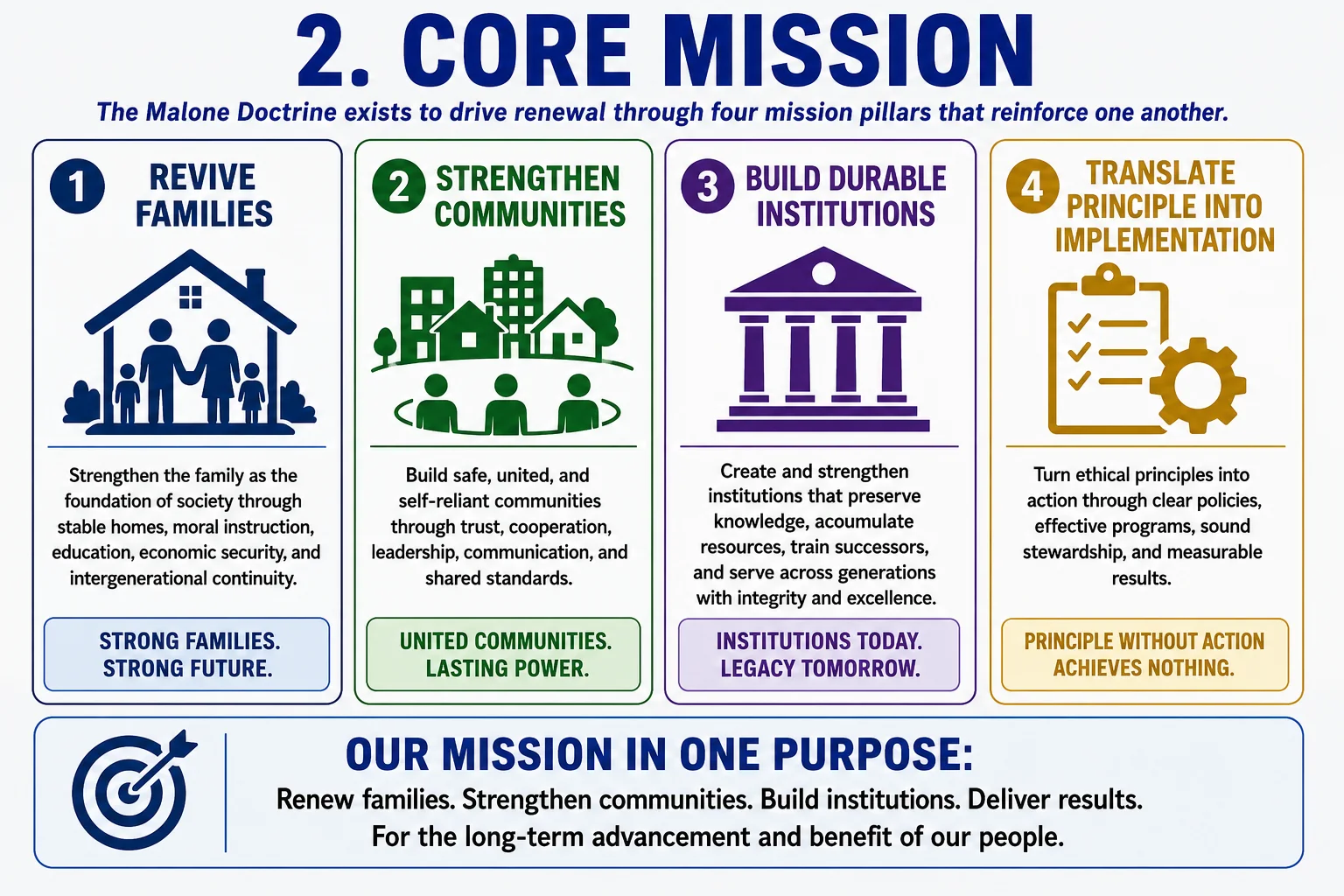
The four mission pillars describe the Doctrine’s practical direction.
Revive families
The family is treated as a foundational social institution.
Family revival may include:
- stronger parenting and household stability;
- education and child development;
- economic security;
- intergenerational continuity;
- moral instruction;
- protection from destructive social conditions; and
- improved relationships between individuals, families, and communities.
The Doctrine assumes that broad community revival cannot be sustained while families remain unstable or unsupported.
Strengthen communities
This moves from the household level to collective life.
Community strength requires more than geographic proximity or shared identity. It requires:
- trust;
- cooperation;
- leadership;
- communication;
- local institutions;
- dispute-resolution mechanisms;
- economic networks;
- shared standards; and
- the capacity for collective action.
Build durable institutions
The Doctrine places major emphasis on institutions because individual achievement alone does not create lasting collective capacity.
Durable institutions should be able to:
- preserve knowledge;
- accumulate resources;
- train successors;
- coordinate people;
- survive leadership transitions;
- deliver services;
- defend their mission; and
- operate across generations.
Translate principle into implementation
This pillar prevents the Doctrine from becoming purely philosophical.
A principle such as justice, preparedness, honesty, or institutional independence must eventually become:
- a rule;
- a policy;
- a procedure;
- a program;
- a budget;
- an assignment;
- a measurement system; or
- an institutional response.
The purpose is to connect belief with execution.
Authority Structure
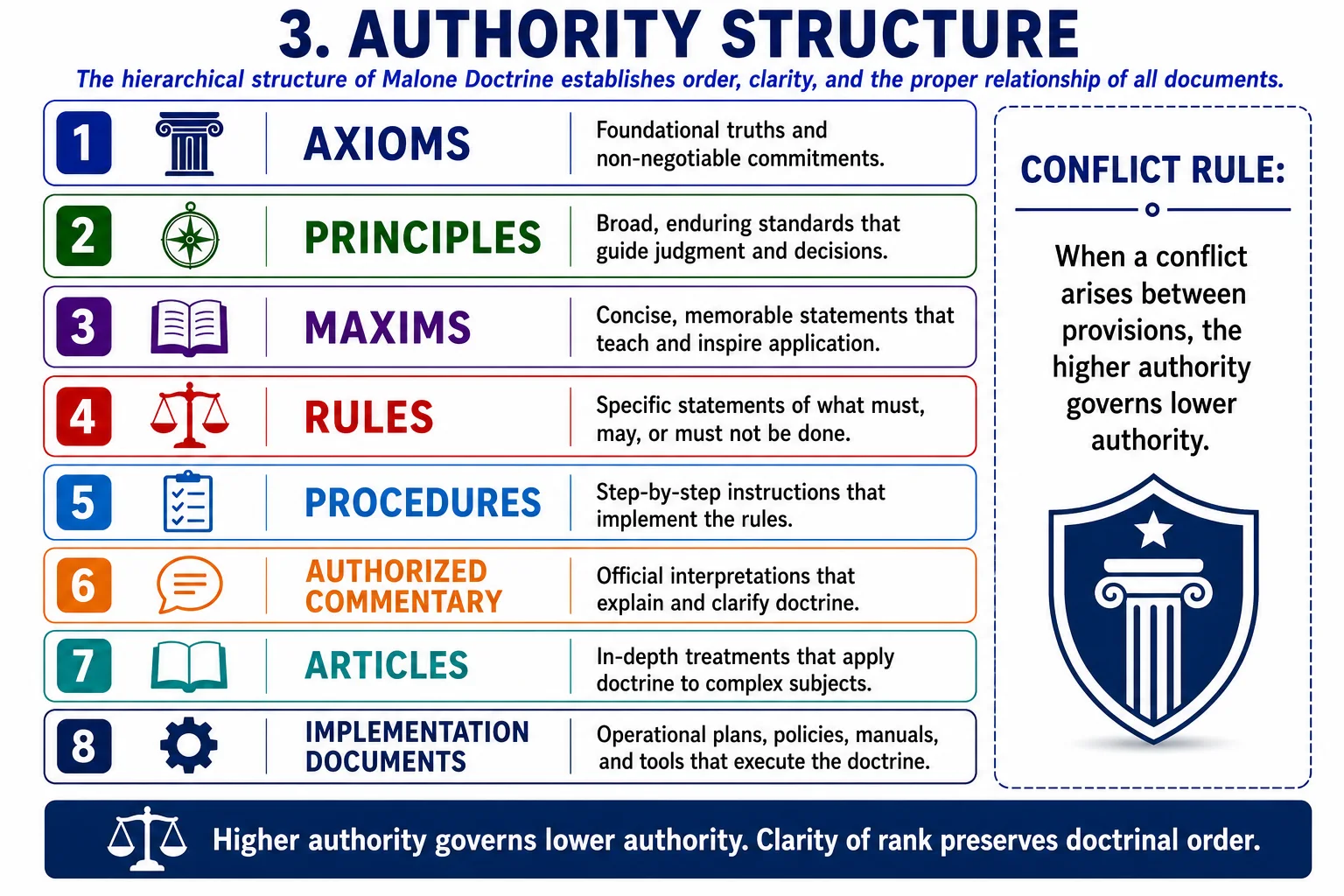
This section shows the hierarchy of Malone Doctrine documents.
The central idea is that not every statement has equal authority.
Axioms
Axioms are the foundational propositions of the Doctrine.
They establish the basic assumptions that the rest of the system depends upon. They should be highly stable and rarely altered.
An axiom answers questions such as:
- What fundamental realities does the Doctrine recognize?
- What commitments are non-negotiable?
- What truths support all lower-level rules?
Principles
Principles convert foundational axioms into broad standards of judgment.
They guide decisions across many different situations without necessarily prescribing one exact action.
For example, a principle might govern justice, leadership, institutional independence, responsibility, preparedness, or human dignity.
Maxims
Maxims are concise teaching statements that make broader principles easier to remember and apply.
Examples include:
- Lead by example.
- Knowledge is power.
- Confirm then verify.
Maxims are practical aids, but they remain subordinate to axioms and principles. A maxim should not be interpreted in a way that contradicts a higher authority.
Rules
Rules state what must, may, or must not be done.
They are more specific than principles.
A rule could govern:
- conduct;
- institutional separation;
- conflicts of interest;
- leadership obligations;
- use of funds;
- evidence standards; or
- decision-making authority.
Procedures
Procedures explain how a rule is implemented.
A rule might require institutional review. The corresponding procedure would explain:
- who conducts the review;
- what evidence is required;
- how findings are recorded;
- who approves the decision; and
- what happens afterward.
Authorized Commentary
Authorized commentary explains how higher-level doctrine should be understood.
Its purpose is interpretation rather than creation of superior authority.
It may clarify:
- difficult language;
- historical context;
- apparent conflicts;
- intended applications;
- limitations; and
- relationships between provisions.
Articles
Articles are extended treatments of a subject.
They may combine doctrine, definitions, diagnosis, governing rules, threat analysis, ethical requirements, implementation guidance, and measures of success.
An article provides depth that a short axiom, principle, or rule cannot provide.
Implementation Documents
These are the most operational materials.
They may include:
- strategic plans;
- institutional policies;
- program designs;
- manuals;
- directives;
- organizational plans;
- assessment tools;
- budgets; and
- implementation schedules.
They translate the Doctrine into institution-specific action.
Conflict rule
Higher authority governs lower authority.
This means a procedure cannot override a rule, a rule cannot override a principle, and an implementation document cannot override the Doctrine’s foundational axioms.
When two provisions conflict, the higher-ranking authority controls.
Four Ethical Domains
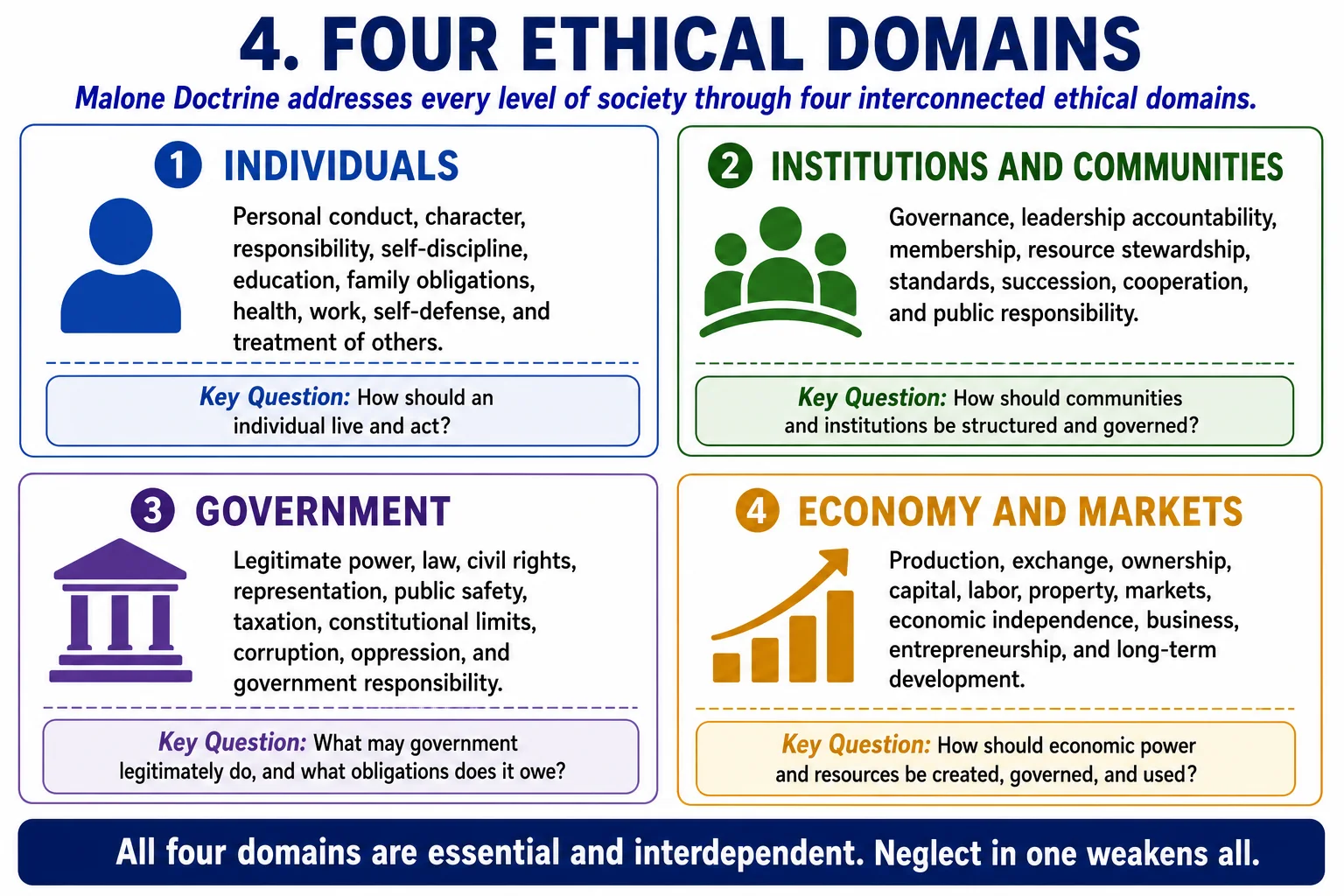
Four Ethical Domains
These domains organize the Doctrine according to the level of society being governed or evaluated.
1. Individuals
This domain concerns personal conduct and responsibility.
It may address:
- character;
- honesty;
- discipline;
- education;
- family obligations;
- self-defense;
- work;
- leadership;
- health;
- financial responsibility; and
- treatment of other people.
The central question is: How should an individual live and act?
2. Institutions and Communities
This domain governs organized groups and collective social life.
It may address:
- institutional purpose;
- governance;
- leadership accountability;
- membership;
- succession;
- community standards;
- resource stewardship;
- institutional independence;
- cooperation; and
- public responsibility.
The central question is: How should communities and institutions be structured and governed?
4. Economy and Markets
This domain concerns the production, exchange, ownership, and distribution of resources.
It may address:
- business;
- labor;
- capital;
- property;
- markets;
- charitable finance;
- economic independence;
- exploitation;
- entrepreneurship;
- institutional wealth; and
- long-term development.
The central question is: How should economic power and resources be created, governed, and used?
Two Working Lanes
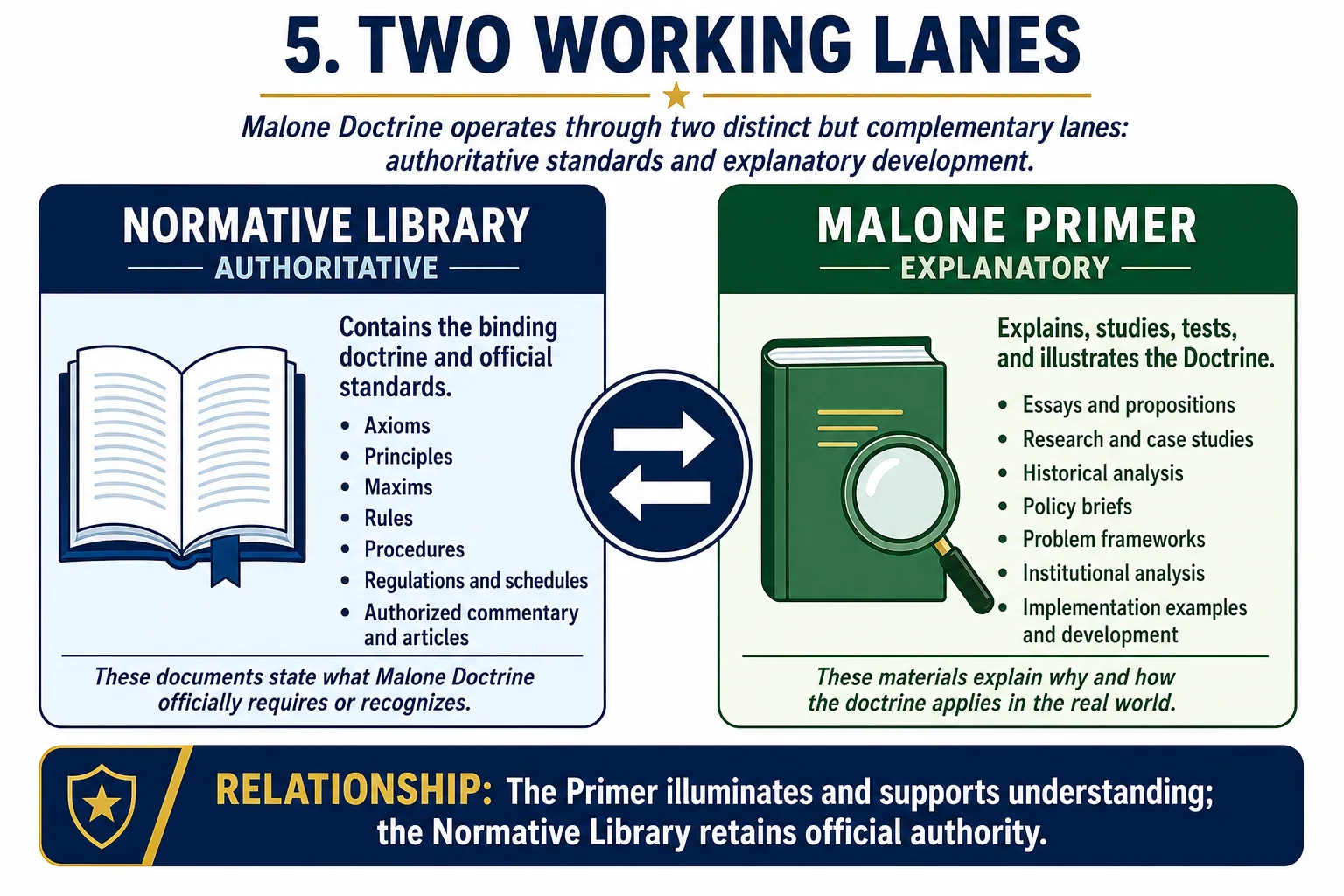
This section distinguishes the authoritative Doctrine from the explanatory work surrounding it.
Normative Library
The Normative Library contains the documents that state what Malone Doctrine officially requires or recognizes.
It includes:
- binding doctrine;
- axioms;
- principles;
- maxims;
- rules;
- procedures;
- regulations;
- schedules; and
- other formally authorized materials.
“Normative” means the documents establish standards, obligations, authority, or official interpretation.
These materials answer:
What does Malone Doctrine officially say?
Malone Primer
The Malone Primer explains, studies, tests, and illustrates the Doctrine.
It may contain:
- essays;
- research;
- arguments;
- case studies;
- historical analysis;
- policy briefs;
- problem frameworks;
- propositions;
- institutional analysis; and
- implementation examples.
These materials answer:
Why does the Doctrine take this position, what problem is it addressing, and how might it be applied?
Relationship between the lanes
The Primer supports understanding, but it does not automatically possess the same authority as the Normative Library.
A persuasive Primer essay cannot override an adopted axiom or rule.
This separation protects the Doctrine from being unintentionally altered every time someone writes an analysis, commentary, or research paper.
Seven Strategic Problem Areas
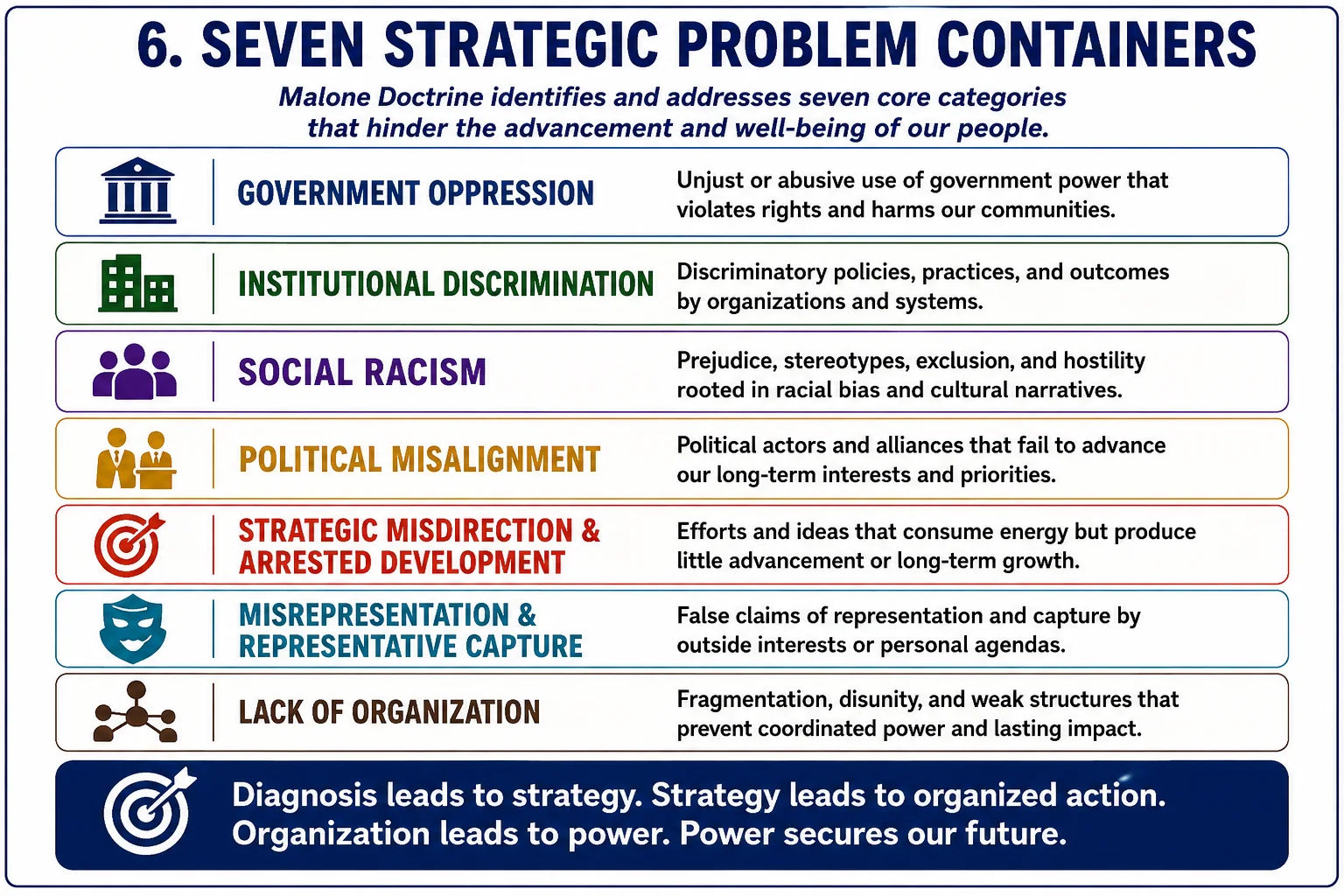
These are broad categories used to organize diagnosis, research, policy analysis, and strategic responses.
They are called containers because each category can hold many distinct events, institutions, policies, case studies, and forms of evidence.
1. Government oppression
This category addresses harmful or unjust uses of government power.
Examples could involve:
- discriminatory laws;
- unequal enforcement;
- political repression;
- surveillance;
- wrongful deprivation of rights;
- state violence;
- exclusion from public institutions; or
- policies producing foreseeable group harm.
The category should distinguish documented government action from unsupported allegations.
2. Institutional discrimination
This concerns discrimination by organizations other than, or in addition to, government.
It may involve:
- employers;
- schools;
- banks;
- housing systems;
- professional bodies;
- media institutions;
- healthcare systems;
- corporations; or
- nonprofit organizations.
The focus is on systems, policies, practices, and outcomes rather than solely personal prejudice.
3. Social racism
This category concerns racial hostility, stereotypes, exclusion, degradation, and discriminatory conduct within society.
It may include:
- interpersonal behavior;
- cultural narratives;
- media representations;
- social norms;
- informal exclusion;
- dehumanization; and
- inherited racial attitudes.
It differs from institutional discrimination because social racism may operate without a formal institutional policy.
4. Political misalignment
This concerns the failure of political representation, parties, movements, or alliances to advance the actual long-term interests of the population they claim to serve.
It asks:
- Are political commitments producing results?
- Are communities receiving value for their loyalty?
- Are representatives accountable?
- Are short-term political gestures replacing strategic gains?
- Are alliances consistent with doctrinal goals?
5. Strategic misdirection and arrested development
This category examines efforts, ideas, or institutions that consume energy without producing meaningful advancement.
“Strategic misdirection” means attention and resources are directed toward ineffective or counterproductive objectives.
“Arrested development” means individuals, organizations, or communities remain trapped at an immature stage of capacity.
Examples may include:
- symbolic action without institution-building;
- repeated protest without durable organization;
- dependence without succession planning;
- slogans replacing policy;
- reaction replacing strategy; or
- movements that cannot transition into competent institutions.
6. Misrepresentation and representative capture
This category concerns people or organizations claiming to represent a population without genuine accountability to that population.
Misrepresentation may involve false, exaggerated, or self-appointed claims of leadership.
Representative capture occurs when supposed representatives become controlled by outside funders, parties, institutions, ideological interests, or personal incentives.
The central concern is the difference between:
- being visible and being accountable;
- speaking about a group and being authorized by it;
- personal advancement and community advancement.
7. Lack of organization
This is presented as a central structural problem.
Without organization, a population may have large numbers, talent, grievances, and resources but still lack coordinated power.
Lack of organization may produce:
- fragmented leadership;
- duplication of effort;
- weak negotiation capacity;
- poor information sharing;
- inconsistent strategy;
- inability to accumulate capital;
- dependence on external institutions; and
- failure to preserve gains across generations.
This category connects directly to the Doctrine’s emphasis on institution-building.
Institutional Ecosystem
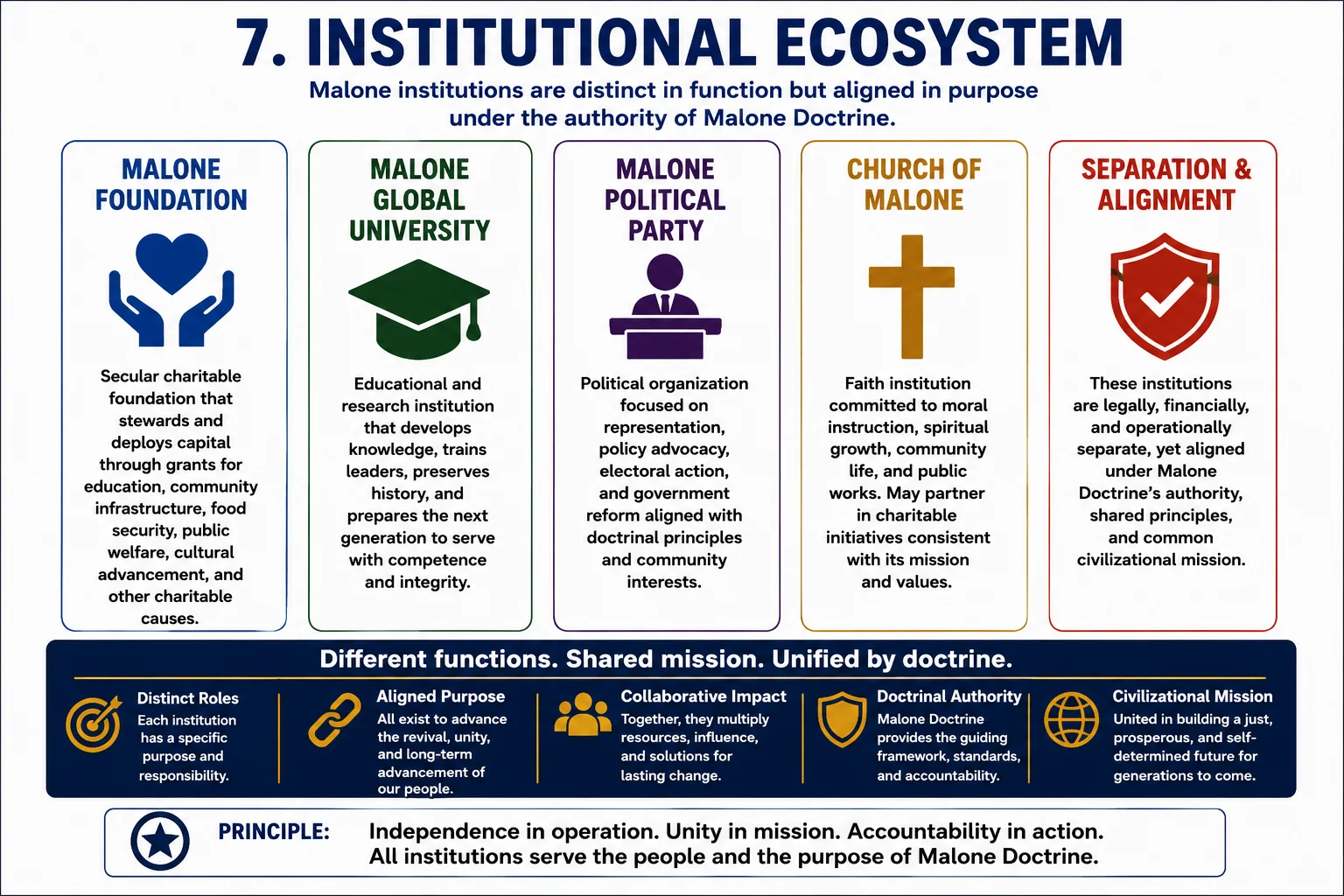
This section shows how major Malone institutions may operate within the broader system.
The key principle is alignment without improper consolidation.
Malone Foundation
The Foundation is presented as a secular charitable grantmaking institution.
Its role is to steward and deploy charitable capital toward purposes such as:
- education;
- community infrastructure;
- food security;
- public welfare;
- cultural advancement;
- institutional development; and
- other legally charitable causes.
It should remain legally, financially, and operationally separate from the Church, University, and political party.
Malone Global University
The University serves the educational, research, training, and intellectual-development functions of the system.
It may:
- produce curricula;
- publish research;
- train leaders;
- preserve knowledge;
- develop professional skills;
- conduct policy analysis; and
- educate the public.
It is not identical to the Doctrine. Rather, it studies, teaches, and applies relevant parts of it within an educational jurisdiction.
Malone Political Party
The political party serves political organization, representation, policy advocacy, electoral activity, and public action.
It may translate doctrinal priorities into:
- platforms;
- campaigns;
- legislation;
- political education;
- candidate development;
- constituency organization; and
- government reform.
Because it is political, it must remain separate from the secular charitable Foundation and operate under the laws governing political organizations.
Church of Malone
The Church is a separate faith institution.
Its possible roles may include:
- religious formation;
- moral teaching;
- community life;
- charitable or public works;
- spiritual leadership; and
- implementation of eligible grant-funded programs.
The Church may be aligned with Malone Doctrine, but it should not be legally or institutionally merged with the Foundation or University.
Separation note
These institutions are separate but may be aligned under the doctrine.
This is one of the most important statements in the infographic.
The institutions can share broad objectives while maintaining distinct:
- legal identities;
- boards;
- finances;
- leadership structures;
- regulatory obligations;
- operating procedures; and
- jurisdictions.
The Doctrine provides alignment. It should not erase necessary institutional boundaries.
Guiding Maxims
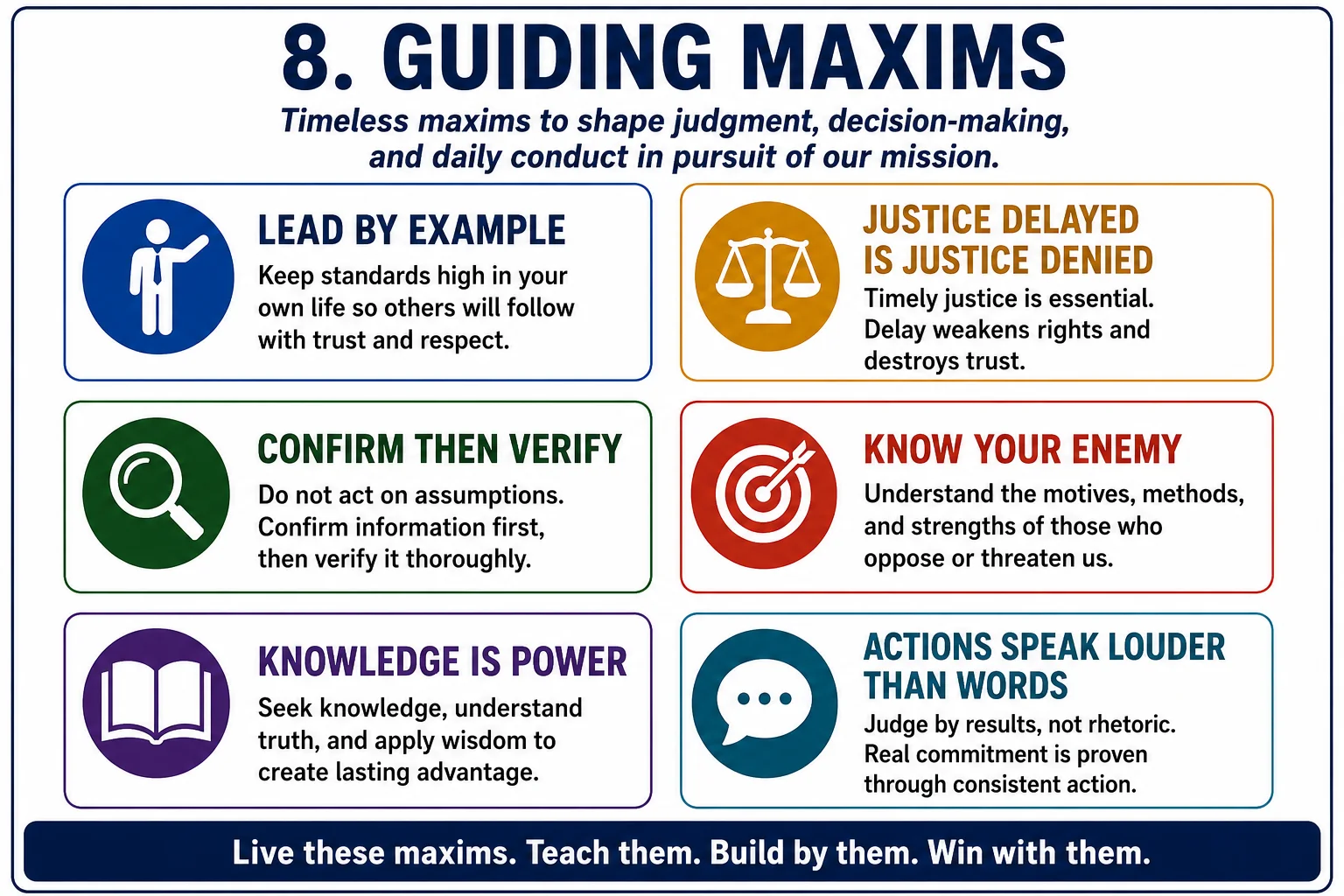
These maxims illustrate the Doctrine’s practical operating mentality. They are memorable teaching devices, not substitutes for complete rules or analysis.
Lead by example
Authority should be demonstrated through conduct.
A leader should not demand standards that the leader refuses to observe.
This maxim supports credibility, discipline, and institutional trust.
Confirm then verify
This establishes a disciplined approach to information.
“Confirm” means determine that a claim has enough initial support to merit attention.
“Verify” means independently test its accuracy, context, evidence, and reliability.
The maxim discourages both blind acceptance and reckless dismissal.
Knowledge is power
Information, education, research, historical understanding, and technical competence increase the ability to make effective decisions.
However, knowledge becomes strategically useful only when it is organized, communicated, protected, and converted into action.
Justice delayed is justice denied
A right or remedy that arrives too late may have little practical value.
The maxim emphasizes:
- timely adjudication;
- prompt institutional response;
- accountability;
- prevention of prolonged harm; and
- the importance of functional rather than merely theoretical justice.
Know your enemy
This maxim concerns situational awareness.
It does not require indiscriminate hostility. It requires understanding the objectives, capabilities, methods, incentives, alliances, and vulnerabilities of hostile or competing actors.
It also requires accurate classification. Misidentifying an ally as an enemy—or an enemy as an ally—creates strategic failure.
Actions speak louder than words
Claims, slogans, promises, and declarations should be evaluated against conduct and results.
The maxim encourages performance-based judgment.
For institutions, this means examining:
- budgets;
- decisions;
- personnel;
- outcomes;
- repeated behavior; and
- actual allocation of resources.
Strategic Outcome
The final banner summarizes what successful application of the Doctrine is intended to produce.
Moral clarity
People and institutions should understand:
- what they believe;
- what they are obligated to do;
- what they oppose;
- what standards govern judgment; and
- how conflicts should be resolved.
Institutional coherence
Organizations should have compatible purposes, properly defined jurisdictions, clear authority, and noncontradictory operating structures.
Coherence does not mean every institution performs the same function. It means their functions fit together without unnecessary conflict or duplication.
Organized action
Ideas should result in coordinated execution.
This includes:
- leadership;
- plans;
- personnel;
- resources;
- schedules;
- accountability;
- communication; and
- measurable outcomes.
Long-range civilizational development
The Doctrine is intended to operate beyond immediate campaigns or individual lifetimes.
Civilizational development means creating enduring capacity in areas such as:
- family;
- education;
- culture;
- political power;
- economic strength;
- law;
- institutional knowledge;
- leadership succession; and
- intergenerational advancement.
In that sense, the infographic presents Malone Doctrine as a system for moving from ethical principle, through institutional organization, toward long-term collective development.